0

COVID-19: Mandatory testing and a safe work environment

With South Africa currently under a declaration of a National Disaster, some questions remain regarding the constitutionality of mandatory testing and a person’s right to refuse.

There are some who hold the view that being obligated to be tested is a violation of his or her constitutional right. However, under the National Disaster proclamation, certain limitations on constitutional rights are viewed to be both fair and just.

The Department of Co-operative Governance and Traditional Affairs published regulations determining that a person who is suspected to have Covid-19, or who has come into contact with someone who has Covid-19, may not refuse to be tested or quarantined. A warrant may be used to force compliance if a person refuses to be tested or quarantined.

In terms of workplace health, according to a document published by the Information Regulator of South Africa dated 03 April 2020, employers can force their workers to be tested for the SARS-CoV-2 virus behind Covid-19 illness.

In “GUIDANCE NOTE ON THE PROCESSING OF PERSONAL INFORMATION IN THE MANAGEMENT AND CONTAINMENT OF COVID-19 PANDEMIC IN TERMS OF THE PROTECTION OF PERSONAL INFORMATION ACT 4 OF 2013 (POPIA)” which focusses on the protection of personal information gathered for the purpose of containing the spread of COVID-19, a section deals with the question of consent and workplace obligation under Sections 6 and 7:

6.1 Can the employer request specific information on the health status of an employee in the context of COVID-19?

Yes, the employer is obliged to maintain a safe and hazardous free working environment in terms of the Occupation Health and Safety Act 85 of 1993 read together with the Employment Equity Act 55 of 1998, if an employee’s health status may endanger other employees. The disclosed information should not be used to unfairly discriminate against such an employee.

6.2. Can the employer force an employee to undergo testing for the COVID-19 virus?

Yes, the employer can force an employee to undergo testing in order to maintain a safe working environment.

  1. CONSENT

7.1. Can a data subject refuse to give consent to be tested for COVID-19?

No, the Regulations require any data subject to undergo mandatory testing in order to manage the spread of COVID-19.

Furthermore, section 8 addresses the mutual responsibility of an employee to maintain a safe working environment by disclosing their COVID-19 positive status to their employer:

  1. GENERAL

8.1. Does a person who has tested positive for COVID-19 have a duty to disclose his or her status?

Yes, a person who has tested positive has a duty to disclose his or status to enable the Government to take appropriate measures to combat the spread of COVID-19.

Thus, an employer may obligate an employee to be tested for COVID-19, and under the regulations of the National Disaster Act, the employee can legally be forced to comply.
0

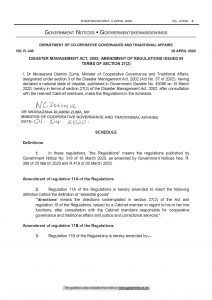
COVID-19: Updated and amended lock down regulations 02 April 2020

Updated and amended regulations to address issues regarding transport, essential goods and the tracking of the coronavirus was signed and gazetted by Minister Nkosazana Dlamini-Zuma on 02 April 2020.

The changes include:

Funerals

  • Provision for certain individuals to be allowed to travel between provinces, metropolitan areas and districts for the purpose of transporting mortal remains for burial.
  • A process by which persons who wish to travel between provinces, metropolitan and districts to attend a funeral or cremation can obtain a permit, provided they are:
  • The spouse or partner of the deceased.
  • Children of the deceased, whether biological, adopted or stepchildren.
  • Children-in-law of the deceased.
  • Parents of the deceased whether biological, adopted or stepparents.
  • Siblings, whether biological, adopted or stepbrother or sister of the deceased.
  • Grandparents of the deceased.
  • Persons closely affiliated to the deceased.

Tracking

  • The creation of a confidential national database that will allow for the tracing for people who has, or who have been in contact with someone who has the coronavirus.
  • The database will collect personal information on persons when they are tested.
  • Government may also request information from electronic communications service providers such as mobile networks and ISPs, including location and movement.
  • The database will include (but is not limited to) the following information:
  • First name
  • Last name
  • Identity/Passport number.
  • Residential address.
  • Work address/Other addresses where they could be located
  • Cell phone number
  • Covid-19 test results
  • The personal details of all known or suspected contacts of a person who has tested positive for the virus.

Spaza shops and informal traders

  • Grocery stores and wholesale produce markets, including spaza shops and informal food traders, may operate but must obtain a permit from a municipal authority to operate.

These changes are gazetted in the Government Gazette 43199 on 02 April 2020, please follow the link for the full publication.

0

COVID-19 Updates in lockdown regulations 01 April 2020

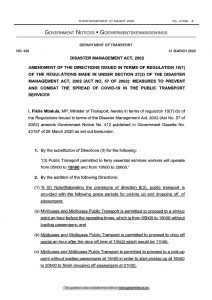
Minister of Transport, Fikile Mbalula, has issued a series of updates to the regulations in action during the national lockdown to facilitate better access to transport to vulnerable persons in response to citizens having difficulty finding transport to collect social grants.

According to government gazette 43183 (30Mar2020), “Busses and taxis shall be permitted to operate from 05h00 to 20h00 in order to cater the transport needs of South Africans most vulnerable which is effective from 30 March 2020 until 03 April 2020.”

A further amendment extends the period of validity for driver’s and vehicles for the period of the lockdown, and further 30 days grace period from the date of the end of the lockdown period. Motor Trade number licenses are extended a grace period of 6 months from the date of the end of the lockdown period. Licensing and vehicle test centres will remain closed for the lockdown.

The designation of essential workers have also been extended to include:

  • Tollgate operators
  • Road Emergency operators
  • Employees responsible for safe operation of the roads
  • Rail logistics operators

Government gazette 43186 (30Mar2020) grants a grace period to taxis to proceed to and from the pick-up points an hour before the designated times, without loading passengers, as set out in the Disaster Management act. Taxis are permitted to collect and return essential workers from 05h00 to 10h00 and 16h00 to 22h00. The amendment continues to say that private institutions or companies may plan transport for their essential workers (as listed in Annexure B of the Disaster Management act) to be in line with operating shifts and work time schedules. These operating shifts or work schedules must be stamped and signed by the responsible person.

This amendment also increases the permitted load capacity of minibus taxis to 70 % where no masks are required, meaning a taxi with a licensed capacity of 10 persons may carry 7, a capacity of 15 may carry 10 and a capacity of 22 may carry 15. In all cases the allowed number of persons in the vehicle includes the driver. A vehicle licensed for 4 persons is still limited to a 50 % permitted load capacity, meaning only 2 persons may be in the vehicle including the driver. However, during the lockdown period a minibus taxi will be permitted to carry a full load as licensed provided all persons in the vehicle is wearing either a surgical or N95 mask.

Government Gazette 43189 (30Mar2020) extends the ban on all local and international flights irrespective of the risk status of the country of origin except where granted specific permission by the Minister of Transport to evacuate South African citizens in foreign countries. Repatriation is allowed only where the foreign countries charter an aircraft to South Africa without passengers but with a crew – whom will not be allowed to disembark the plane in South Africa. South African citizens who wish to return to the country during this time will be permitted to do so provided:

  1. They have a fully paid return flight ticket, and
  2. They will submit to a mandatory quarantine period of up to 21 days.

The following technical flights are allowed:

  1. Medical Evacuation flights – these flights should not carry passengers except patients and crew who, upon disembarking, will be subject to the mandatory quarantine laws as are applicable.
  2. Aircraft in a state of emergency
  3. Overflights
  4. Technical landings for refuelling – these flights are allowed provided no passengers are allowed to disembark the plane.
  5. Aircraft operations related to humanitarian aid, relief flights and other safety related operations.

The following airports must have operation staff on standby to receive aircraft in distress:

  • Port Elizabeth
  • Bram Fisher
  • Upington
  • Polokwane
  • Kruger Mpumalanga

Flight Cargo crew will be permitted to disembark on the condition that they will be subject to quarantine laws as applicable.

Government Gazette 43183
Government Gazette 43186
Government Gazette 43189
2

COVID-19: TERS Application for UIF benefits update

All employers are required to register for the TERS benefit by sending an e-mail to covid19ters@labour.gov.za, but employers with more than 10 employees as well as employers using a payroll system, will be required to complete the Memorandum of Agreement (MOA) which can be received through an auto reply to the email address covid19ters@labour.gov.za or as linked here.

These employers will receive a bulk payment from UIF and will be responsible for the distribution of the funds to its employees and provide an audit trail. Employers with 10 or less employees will not have to distribute the funds as employees will be paid directly by UIF.

If an Employer has less than 10 employees and/or no payroll system, they will not be required to complete the MOA and can follow the easy prescribed method.

All employers will receive an automated response from covid19ters@labour.gov.za and a number of compulsory documents will be provided.

Employers are encouraged to submit claims as soon as possible as it will take UIF some time to process the large number of expected claims. Any subsequent updated documents will supersede any outdated documents already submitted.

Employers should note that claims should be mailed to covid19claims@labour.gov.za.

Please note that employers who resort under a bargaining council, should confirm with such a council whether it has reached an agreement with UIF in respect of TERS benefits, in which case claims must be submitted through the relevant bargaining council in accordance with that particular agreement.

Employers are reminded to not claim UIF unless the situation is dire, or withhold funds from employees, as the UIF can issue an audit on your account at any time. If it is deemed that money has not been paid to employees or misappropriated employers will be held liable by the law.

List of required documents for TERS application (templates linked):

  1. Letter of Authority
  2. Memorandum of Agreement (MOA)
  3. Prescribed template that will require critical information from the Employer
  4. Confirmation of Employer details
  5. Evidence / payroll as proof of last three months employee(s) salary/ies
  6. Confirmation of Employer bank account details in the form of a certified latest bank statement.

References (linked):

(i)                Covid -19 TERS EASY AID GUIDE

(ii)               The body of the Auto Reply Email received from UIF


0

COVID-19: Clothing industry reaches agreement on payment of wages

An collective agreement by the Bargaining Council for the Clothing Manufacturing Industry regarding the payment of wages to employees in the clothing sector during the national lock down to combat the spread of the Coronavirus, has been extended to non-parties in the industry by the Minister of Employment and Labour, with effect from 26 March 2020.

The primary aim of this agreement is to ensure that workers are not left to face the lock down period without income. The clothing manufacturing industry agrees that it cannot be left up to government alone to address the impact of the lock down on industry and employees and will play a supportive role in this effort.

This agreement is in effect as of 26 March 2020 and determines that employers in the industry and the Unemployment Insurance Fund (UIF) will take turns to pay the employees’ weekly wages for a provided 6-week period despite the lock down period being only 3 weeks long.

Payments will be scheduled as follows:

Week 1

The employer will pay deferred wages for work performed during the week prior to the lock down.

Week 2

a – The employer will pay deferred wages for work performed      during the week of the lock down,

b – The balance of the wages will consist of workers’ funds received from the UIF in cases where the lock down started before a full week’s work was performed.

Week 3

The employer will pay a full week’s wages.

Week 4

Worker’s funds from the UIF will pay a full week’s wages.

Week 5

The employer will pay a full week’s wages.

Week 6

Worker’s funds from the UIF will pay a full week’s wages.

All payments due to employees from the employer during the first two weeks shall be paid to employees, irrespective of whether funds were received from the UIF. All normal statutory deductions shall also continue to be effected during this 6-week period.

1 2 3